 |
| "Match It and Prove It" set up for the game. |
December 2, 2014
Match It and Prove It
After reviewing percent problems and introducing the concept of "commissions" to the students, we moved into introducing a game among partners. The name is "Match It and Prove It." Students shuffle and spread the question cards facing up on their table. Next, they shuffle the answer cards and place them facedown in a pile. The first student turns over an answer card and both students compete to match the problem to the correct answer to prove that the match is mathematically correct. The person who matches the question and answer correctly keeps both cards. If neither student gets the correct answer, the answer card is placed at the bottom of the answer card pile. Students take turns turning over answer cards. Students were required to keep a record of question cards answered withe the answers along with their work on the sheets provided in their MTN's.

December 1, 2014
Test 3 Update
Test Retakes were returned to students today. Some students needed to finish their retakes today, thus will receive the results tomorrow. If a student wishes to retake the test a third time, then the student must make arrangements with me. There are still some students grappling with the concept of working with percents. Therefore, students that are still struggling with percents worked with me with additional examples to practice (there is a homework assignment for tonight -- 2 examples). Meanwhile, students that are all set worked on IXL to practice other skills ("Percentage Change" Level I: K.9 and K.10 and "Guess and Check Word Problems" Level J: M.2).
November 25, 2014
If you were absent on Monday and/or Tuesday of this week:
I will review Test 3 with you after the Thanksgiving break and give you an opportunity to retake the test (if necessary). Make sure you have copied notes from Monday -- 2 sets: "Ways to Improve/Maintain MTN" and "Percentage Change -- Increase and Decrease." The "Percentage Change -- Increase and Decrease" MUST be copied in BOTH your MTN (math journal) and ISN (science journal)!
Wishing you and your family a safe and enjoyable Thanksgiving Holiday!

November 24, 2014
Ways to Improve/Maintain MTN AND Percentage Change
Review of Test 3 was conducted today along with "Ways to Improve/Maintain MTN." I encourage students to use their notes for taking a test. However, when notes are incomplete or difficult to read/follow, using notes often times becomes a moot point. After reviewing the correct methods and answers for the recent test, we reviewed how to have a usable MTN.
The retake for Test 3 is tomorrow, Tuesday, 11/25/14.
Make sure your TOC is up -to-date. Also check to be sure that you have copied the EXAMPLES and DEFINITION to Multiplicative Property of Zero on the Chart for "Other Properties" in your MTN.
The retake for Test 3 is tomorrow, Tuesday, 11/25/14.
 |
| These notes must be written in your MTN. |
Homework for Tonight:
PERCENTAGE CHANGE -- INCREASE OR DECREASE
Notes were given for a science connection (Eggsperiment), which students copied in both MTN and ISN.
INCREASE:
1. Work out the difference (increase) between the 2 numbers you are comparing.
New # - Original # = Increase
2. Divide the Increase # by the Original # and multiply the answer by 100.
3. If your answer is a negative number, then this is a percentage decrease.
DECREASE:
1. Work out the difference (decrease) between the 2 numbers you are comparing.
Orginal # - New # = Decrease
2. Divide the Decrease # by the Original # and multiply the answer by 100.
3. If your answer is a negative number, then this is a percentage increase.
November 20, 2014
Test 3 and Table of Contents
MTN's were collected after students were finished with Test 3. Both MTN's and Test 3 will be returned to students on Monday, November 24. Here is this week's Table of Contents, which had been posted on the class white board all this week:

November 19, 2014
Working with Percents and Fractions
REMINDER: Test 3 is tomorrow, Thurs., 11/20/14
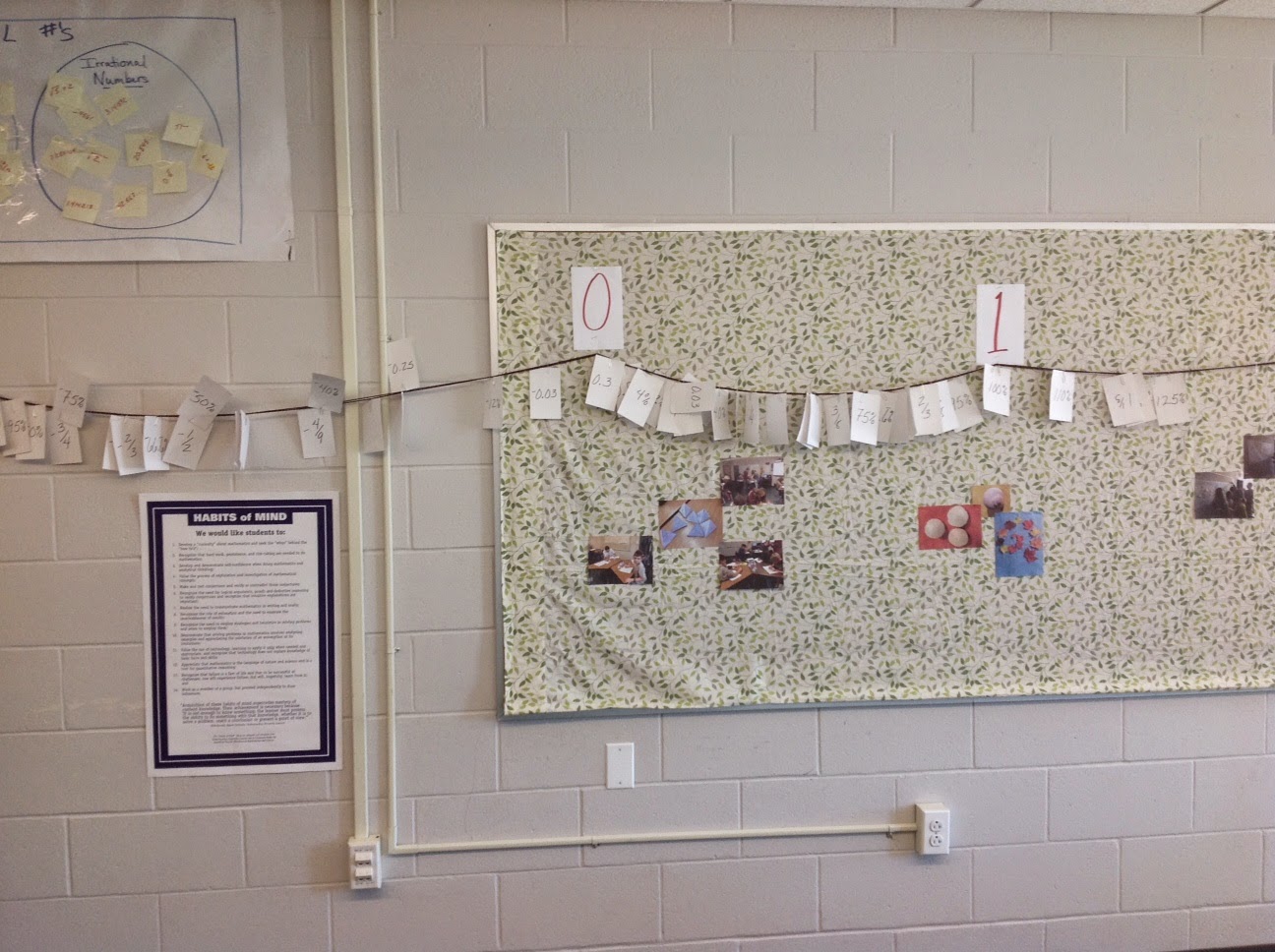
Today, we continued our work with solving problems that deal with sales tax, service tips, and discounts. After reviewing last night's homework with partners, students completed more problems on their own (without guidance). Meanwhile, we continued our building concepts to understanding the value of percents, decimals, and fractions to each other on a number line.
 |
| Answers to Guided Practice. Make sure you have this work in your MTN. |
 |
| Answers to Independent Practice. After you are finishes with your work -- check your answers here. TEST is tomorrow. |

November 18, 2014
Working with Percents
We continued with our work with percents for calculating the sales tax, service tip, and discounts. Using the inverse percents to eliminate subtraction step for discounts, and including one (as the whole) to eliminate the adding step (for tax and tips); when appropriate. These are the word problem sheets in student MTN's:


Homework for tonight: Read notes for Thursday test AND complete items
on Guided Practice sheet in MTN.
 |
| The notes from today's class. |
Homework for tonight: Read notes for Thursday test AND complete items
on Guided Practice sheet in MTN.
November 17, 2014
Distributive Property Review and OTHER PROPERTIES
 |
| Answers: 1. I; 2. B |
You're getting better at using Distributive Property. Let's take a look at your thinking when you have to decide whether or not the model and expression match:
SAMPLE:

PRACTICE ITEMS WITH YOUR PARTNER:

Other Properties Charts were "distributed" to students. This represents properties that will be learned and practiced throughout the remainder of the year. The charts were given out today. All properties and definitions will easy to find in their TOC since their location is in the same area of students' MTN's .
We also filled in the Examples and Definition for Multiplicative Property of Zero:
EXAMPLES: 2 x 0 = 0
1/2 x 0 = 0
-352 x 0 = 0
a x 0 = 0
DEFINITION: The product of any number and zero is zero.

We have also moved to Working with Percents: sales tax, service tips, and discounts. More info on tomorrow's blog.
November 13, 2014
Distributive Property 2
Let's take a look at the models and expressions and discuss how the two match:


Now, let's practice with writing EXPRESSIONS and SIMPLIFY by multiplying:
 |
| The Answers: 1. 4 (1x + 2) = 4x + 8 2. 3 (3x - 1) = 9x - 3 |
 |
| Due Monday, 11/17/14 |

November 12, 2014
Distributive Property 1
Over the next two days, we will be examining the different models to distributive property. After going over the short weekend assignment, we engaged in more practice. Here are today's notes and copy of tonight's homework assignment due tomorrow.
ANNOUNCEMENT: Test 3 (Integers, Properties & Operations with Fractions) Thurs., 11/20; with a Retake on Tues., 11/25.
3 (2x + 5) = 6x + 15


Now try these:

ANNOUNCEMENT: Test 3 (Integers, Properties & Operations with Fractions) Thurs., 11/20; with a Retake on Tues., 11/25.
We can use Distributive Property with variable expressions.
Check out the photos for a visual example of:


Now try these:
Classroom work
a. 4 (2x – 3) b.
3 (x + 4) c.
(3x + 1) 2
Homework for tonight:

November 6, 2014
Properties of Math
Here are the mathematical definitions for our first seven properties:
Homework for over the loooooong weekend is to read over this page from a math book. I have instructed the students to take a look at two examples as to how to use the Distributive Property. Then they are to TRY the three examples under the first example and solve the one problem under the second example.
Have a great weekend and Happy Conferencing!

NAME
|
HINTS
|
EXAMPLES
|
ETYMOLOGY
|
DEFINITION
|
Additive Identity
|
It stays the same or is balanced
|
9 + 0 =
9
Additive
identity is 0.
|
Latin: Identitatem
sameness;
oneness
|
The sum of any number and zero is the original number; zero preserves
the identity of a number.
|
Multiplicative Identity
|
It stays the same or is balanced
|
9 x 1 =
9
Multiplicative identity is 1.
|
Latin: Identitatem
sameness; oneness
|
The product of any number and one is that number; one preserves the
identity of a number.
|
Additive Inverse
|
You undo or go
backwards/reverse
|
9 + (-9) = 0
Additive Inverse is -n
|
Latin: Invertere
turn upside down; turn
about
|
The additive inverse of a number is to reverse the sign in order to
acquire zero.
|
Associative (Addition or Multiplication)
|
You connect with different “groups”.
|
(5 + 15)
+ 4 = 5 + (15 + 4)
OR
(2 x 3)
x 4 = 2 x (3 x 4)
|
Latin: associare
allied, connected, paired, gathering,
grouping
|
The sum or product are the same regardless the order in which addends
or factors are grouped.
|
Commutative (Addition or
Multiplication)
|
You can organize
or “order” in any way
and get the same answer.
|
5 + 4 + 3 = 4 + 3 + 5
OR
15 x 2 x
1 = 1 x 15 x 2
|
Latin: commutare
to change together,
to order
|
The sum or product are the same regardless the order in which addends
or factors are arranged.
|
Distributive (Addition or
Multiplication)
|
You can deal
out or share some-
thing with friends.
|
5 x (7 + 8) = 5 x 7 + 5 x 8
|
Latin: Distributes
to deal out; apportion; separate; share
|
The operations of multiplica-tion and addition or multipli-cation and
subtraction; multi-plying each term inside the parentheses with the term
outside of the parentheses
|
Multiplicative Inverse
|
You undo or go backwards/reverse
|
8 x '/₈ = 1
Multiplicative
Inverse is '/n
|
Latin: Invertere
turn upside down; turn
about
|
The multiplicative inverse of a number is 1/n or to reverse the sign
in order to acquire one.
|
Homework for over the loooooong weekend is to read over this page from a math book. I have instructed the students to take a look at two examples as to how to use the Distributive Property. Then they are to TRY the three examples under the first example and solve the one problem under the second example.
Have a great weekend and Happy Conferencing!
November 5, 2014
Apollo 13
One of the most recognizable quotes of our time is, "Houston, we've had a problem." Today the team watched the 1995 version of Apollo 13. The story behind the movie is also connected to the Blizzard Bag activity that we will be explaining and distributing to students next week.
Definitions to the seven math properties is due tomorrow. Be prepared to share your individual definitions in class.


Definitions to the seven math properties is due tomorrow. Be prepared to share your individual definitions in class.
November 4, 2014
Properties of Math


 | |||
| Property Chart Answers |
ACTION PHOTOS IN ONE OF TODAY'S CLASS


November 3, 2014
Multiplying with Integers
First, background notes were given for multiplying a positive integer with a negative integer. The answer is always negative because of repeated addition:
(EX. 3 x -2 = -2 + -2 + -2 = -6).

Here is a review video clip from Kahn Academy (not shown in class, but shared as to where to find).
Background -- Positive Integer times Negative Integer
More practice with taking notes from a video source (stop - review - start - etc.) took place. The topic was why multiplying two negatives is always positive. As children, we learned that was the "trick". Math today involves the "why" behind the what we do. This video begins to deal with more abstract thinking and proving how the numbers work. Here is the link to today's note taking video:
Why multiplying two negatives is always positive.
HW: Gold Sheet in MTN: Multiplying integers
(EX. 3 x -2 = -2 + -2 + -2 = -6).
Here is a review video clip from Kahn Academy (not shown in class, but shared as to where to find).
Background -- Positive Integer times Negative Integer
More practice with taking notes from a video source (stop - review - start - etc.) took place. The topic was why multiplying two negatives is always positive. As children, we learned that was the "trick". Math today involves the "why" behind the what we do. This video begins to deal with more abstract thinking and proving how the numbers work. Here is the link to today's note taking video:
Why multiplying two negatives is always positive.
HW: Gold Sheet in MTN: Multiplying integers
October 29, 2014
Test 2 Review and Integer Problems
Test 2 was reviewed today and the Retake will be given tomorrow. All students scoring 1 or 2 will be required to retake the test (and were required to take notes for the retake today). All students scoring a 3 have the option to retake and needed to inform me today as to whether or not s/he wished to retake. The retake is only for the item(s) which individual students did not successfully demonstrate understanding the concept.
Then a problem solving worksheet was given to all students to work in pairs and answer 4 questions. Whatever was not finished was homework. Homework is to TRY to solve and show what attempts were made. I WILL NOT be giving an accuracy ranking for homework. What I WILL be evaluating is the notes that students take tomorrow when we go over the assignment in class.
ANSWERS:

Then a problem solving worksheet was given to all students to work in pairs and answer 4 questions. Whatever was not finished was homework. Homework is to TRY to solve and show what attempts were made. I WILL NOT be giving an accuracy ranking for homework. What I WILL be evaluating is the notes that students take tomorrow when we go over the assignment in class.
 | |
| Homework due on 10/30/14 |
ANSWERS:

October 28, 2014
Student-led Conferences - Day 2
In place of core classes, we broke out into basecamp groups and worked on further preparation for student-led conferences. Evidence of their work will be demonstrated at the conferences. Have a good evening.
October 27, 2014
Student-led Conference Set up
The list of requirements for the math portion presentation at student-led conferences was outlined in today's class (see photo). All students were instructed to copy the information from the board into their Agenda Book. The list will remain on one of the white boards through next Thursday. We will be using some class time to assist students with gathering the information, but students will have to spend some time at night checking and organizing their materials at home.
I also photographed one student's Table of Contents (TOC) to assist anyone who may be missing an item or two (page numbers may vary from student to student). Thanks to Cherilynn.


 | ||||
| Student-led Conference Math List of Requirements |
October 23, 2014
Positives and Negatives - Day 2
Here are the results to Guided Practice and Independent Practice sheets. These problems also led to 2 great discussions about "in the black" and "in the red" and "net result" (gross pay versus net pay). I am expecting that all expressions be written with addends (even negatives). That will lead us to the properties of math; any arrangement of addends will allow us to always get the same answer. Can you name the property (law)?


Test 2 have been corrected. I have not yet finished an item analysis from as student tests, and 4 students were absent and have not yet had a chance to take the test. The plan is for them to take the test tomorrow after lunch. Two students asked me about their individual results, which I did show them their tests. The plan is to return all tests to students on Monday.
Test 2 have been corrected. I have not yet finished an item analysis from as student tests, and 4 students were absent and have not yet had a chance to take the test. The plan is for them to take the test tomorrow after lunch. Two students asked me about their individual results, which I did show them their tests. The plan is to return all tests to students on Monday.
October 22, 2014
Positive and Negative Integers
Individuals conceptualize positive and negative integers in different ways. Today we investigated 3 possibilities. The first is a number line or thermometer. Take the example of 10 + (-5). The number line method suggests to start a 10 and pull back or drop down 5 steps or degrees. In either case, you stop at 5. Another way to think about it is looking at the absolute values. Again, our example of10 + (-5) = /10/ + /5/, find the difference, which is 5, then ask - which integer (+ or -) has the higher value; in this case (10) is positive. Thus the difference; 5, and is positive. Finally, look at the values as positive and negative charges. Yes, using 10 + (-5):
An important concept is: n + (-n) = 0. With n = any number.
A example given to the students was -25 - (-25). We've all learned the "trick" is to rewrite the expression as -25 + 25. Then the question was asked -- Why? What is happening? What real life example could represent this expression? After sharing possibilities and extended discussion, students were able to deduce that -25 - (-25) is indicating that (-25) is "taken away." Pretty good. Ask your child about the real life example(s).
 |
| Pictorial representation |
An important concept is: n + (-n) = 0. With n = any number.
A example given to the students was -25 - (-25). We've all learned the "trick" is to rewrite the expression as -25 + 25. Then the question was asked -- Why? What is happening? What real life example could represent this expression? After sharing possibilities and extended discussion, students were able to deduce that -25 - (-25) is indicating that (-25) is "taken away." Pretty good. Ask your child about the real life example(s).
 |
| Whole Class Practice Example: notice the steps. |
 |
| Homework due tomorrow, 10/23/14 |
Subscribe to:
Posts (Atom)