November 15, 2016

The Crow and the Pitcher -- Day 2

After a homework check (Work Habit: Practice to Improve Skills), students participated in a class discussions revolving around what went well, what limitations or issues arose, how do labs work/not work, how "clean" is data, what can you do when work isn't working, and many more.  We also discussed the importance of many trials and taking risks to solving problems.

Then we took a look of many graphs (22/45 constructed and shared with me) -- what examples complied with given instructions and where do improvements need to take place. Tonight's homework is to revise the first graph (or for 23 of the students to construct their first draft of a graph) and complete any unfinished questions from last night.

Roberts' NOTES

Bayle's and Shaw's NOTES


Crow and Pitcher SAMPLE Desmos Graph


HOMEWORK:   Revise the first graph with today's new knowledge.

November 14, 2016

The Crow & the Pitcher -- Day 1

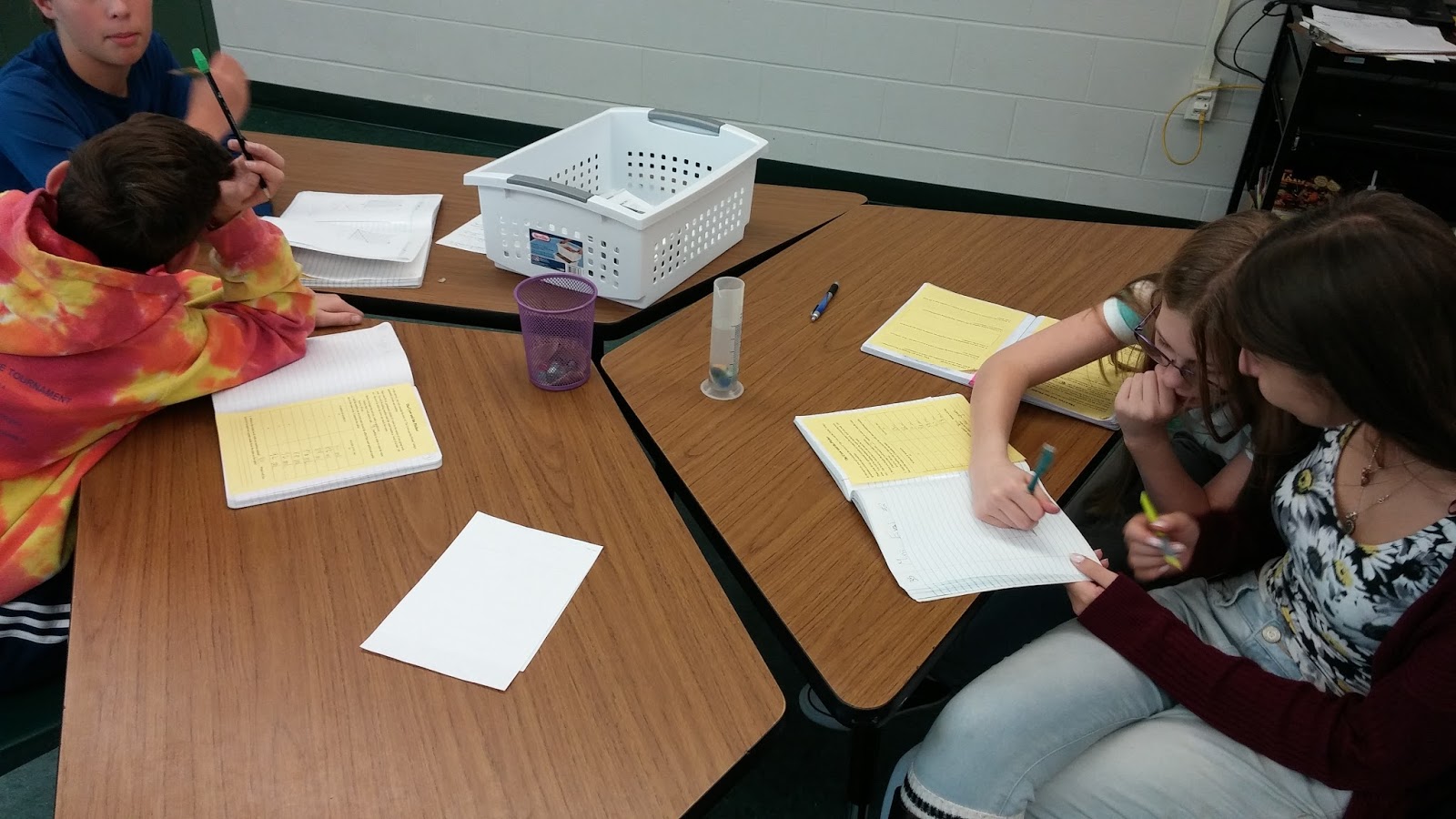
On Thursday, prior to student-led conferences, students were introduced to our new activity. First, students listened to Aesop's Fable, "The Crow and the Pitcher." The moral of this fable can be expresses as: "Little by little does the trick." or "Where there's a will, there's a way." The overview of the activity was explained to the students. Each student recorded his/her prediction as to how many marbles it will take to cause the water level, in a graduated cylinder, to to rise from 80 mL to 100 mL.
After the lab and collecting of data was completed, students answered a series of questions in their partner groups. They were also allowed to consult with their table mates. Students are required to construct a graph on Desmos Calculator Account.


Homework:  Be sure that all questions are answered thoughtfully and you have shared your graph with Mrs. Warren from Desmos.

November 7, 2016

Student Led Conference Presentations

Students are working on their presentations for Student-Led Conferences during all core classes. Today, their focus was on choosing nine work samples from all classes that represent their ability to demonstrating work habits: responsibility for learning, challenges self, and citizenship. Students are constructing a slide presentation that will include work samples and a goal from each work habit.


November 3, 2016

Review of Mini-Eval / New Math Lab

First, I reviewed the answers to Mini-Eval #2, common errors, and gave Mini-Eval #2 - Take 2 to those students wishing to demonstrate their improved skill knowledge.

Then I introduced the next math lab -- "The Crow and the Pitcher," which is an Aesop Fable. We had a few laughs relating the fable to Mrs. Peterson's story about her bird, Vulture. We also had a discussion about the meaning of moral and life examples, to "Little by little does the trick." Three pages were taped into students' MTN's, the procedures were read, and students were given an opportunity to make predictions.

Photos / copies of all pages will be available on the next blog post.  HAVE A GREAT WEEKEND!

HOMEWORK:  None -- EXCEPT if you took advantage of Take 2.  Return to Mrs. Warren in the morning.

TURN YOUR CLOCKS BACK ONE HOUR ON SATURDAY!!

November 2, 2016

Mini-Evaluation #2

Students participated in completing their second summative assessment.

After the assessment, students were given time to update any missing work and table of contents in their individual MTN before turning in.

MTN's and Mini-Evals will be returned to students tomorrow.

HOMEWORK: None for tonight (unless you have missing work).

November 1, 2016

Rate of Change Practice

After homework and notes checks, we discussed last night's question. I explained to students that I will be using their responses to guide me as to what the know/don't know and what I need to teach.

I displayed my Ditch Digger Desmos Graph to discuss rate of change and other components of the graph and y-intercept equation.


Then, I displayed 3 other graphs (one at a time) to give students practice time in determining the rate of change for each, where x and y axis are located, how to determine a positive and negative slope (equation), and how to determine the rise (over) run (aka:slope).


HOMEWORK: Review your notes for Mini-Eval #2 tomorrow.

October 31, 2016

Order - Day 3

Here are the answers for the fractions arrangement:


Notes you should have in your MTN:


HOMEWORK:  The following should be copied in your MTN and have a response ready to discuss in class.

October 27, 2016

Order -- Day 2

Hallway Display:


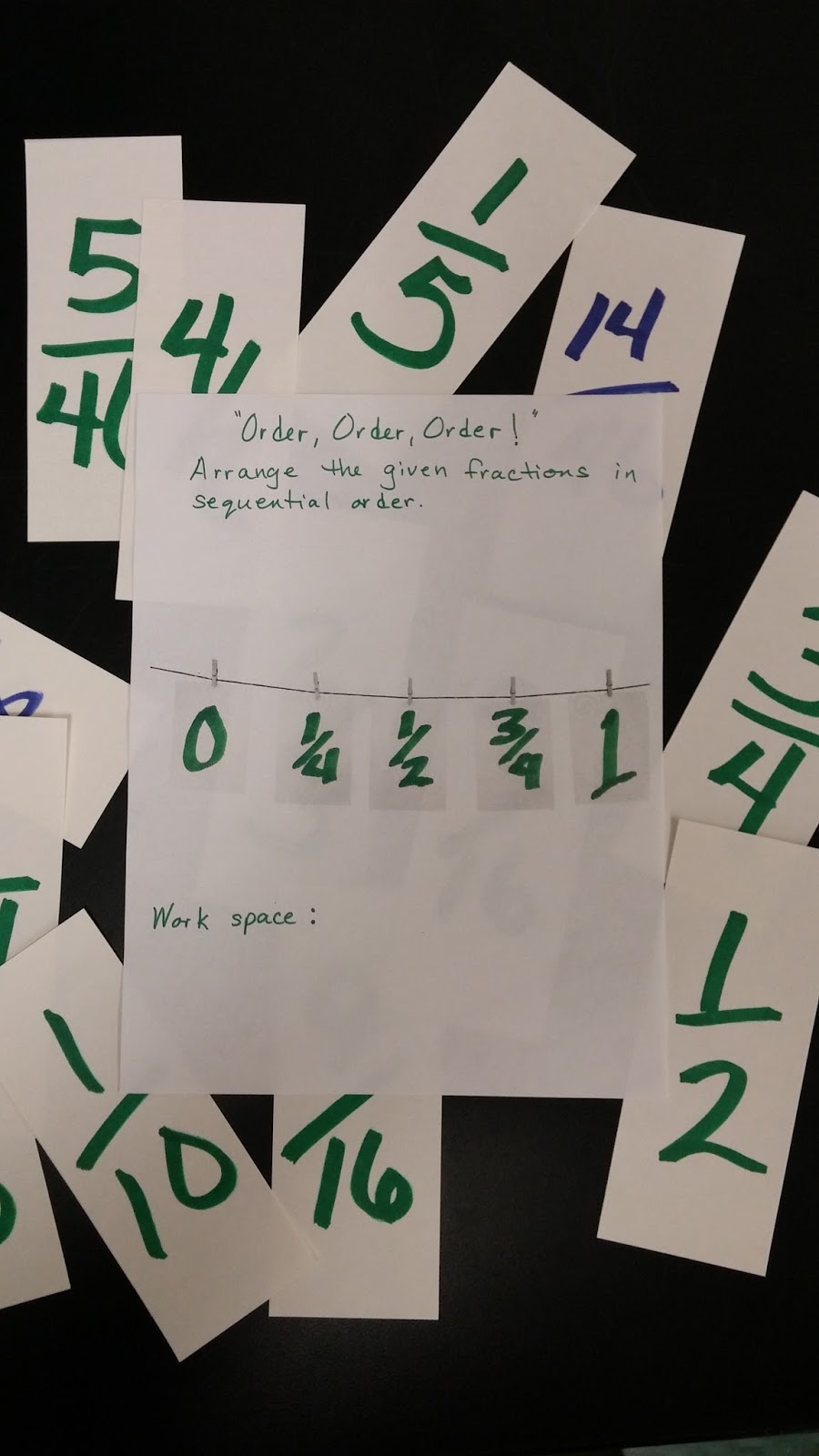
The worksheets that student groups had to work from:


Copies of Reflection Writing Sheets:  (With either choice -- Make sure you tape into your MTN.)
Make a copy -- then print -- then handwrite your responses LINK.

Make a copy -- then type your responses in the boxes -- then print LINK.

Photos of students STRATEGIES brainstorming lists:
Roberts Group
Bayle Group


Shaw Group
Kahn Academy -- Comparing Fractions LINK.

Group Work Pics:
Roberts

Bayle

Shaw


HOMEWORK:
1. Complete "Order" fraction arrangements AND reflection questions in your MTN for Monday.
2. STILL out there:
    ~ Fractal Photo
    ~ Desmos Graph
    ~ Diggers Reflections (Acts 1 & 2)

October 26, 2016

Order, Order, Order

MTN's were returned to students with grades and comments on three reflection assignments.  Paper copies of Desmos graphs from last week's graphing activity was also given to students.

A portion of today's lesson was conducted in the hallway outside the math room. A fractal photo display is located here, along with a fraction number line and flip chart revealing the dates for which the photos were received with the fraction of the completed assignment. Students were especially surprised with 26/46 photos were share one week after the due date. This led to a quick ethics conversation about problem solving when internet and sharing don't work and the importance of on time work completion.

Students returned to the classroom for instructions on their next group task and arranging mixed fractions from least to greatest.

Tomorrow, strategies will be shared and the next steps will be explained.  I will also include photos of work handouts and work sessions.

HOMEWORK:   None for those students caught up.

The following are incomplete for some students:
1. Fractal Photo shared with Mrs. Warren
2. Desmos Graph and share with Mrs. Warren
3. Reflection Responses for Acts 1 and 2

October 25, 2016

Orleans-Hanna

Students participated in the Orleans-Hanna Algebra Prognosis Test. This is used for determining how prepared students may be to learn algebra. This is one indicator used to help predict which seventh grade students will be placed on the Pre-Algebra course standards. For the eighth grade students, O-H helps to make determinations for Algebra high school level placement.

HOMEWORK:  None for those students caught up.

The following are incomplete for some students:
1. Fractal Photo shared with Mrs. Warren
2. Desmos Graph and share with Mrs. Warren
3. Reflection Responses for Acts 1 and 2

October 24, 2016

Tying up Loose Ends

A reminder that Quarter 1 comes to a close on November 4. Thus, the first 10 minutes of class was spent informing students of their missing work (a list is at the bottom of the post).

Next, we went over the thinking required and the correct responses for Mini-Evaluation #1. Anyone may retake the evaluation between now and November 3. Students can see me for retakes before advisory or during A-Block any school day, OR stay after school on a Tuesday or Thursday (must make arrangements with me prior to staying).

I would also like students to go to the following blog posts:

1.  Fractal Link from Bella    (Go to the link and test it out!)
2.  Ditch Diggers - Act 3  (Watch the video)

HOMEWORK:  None --- Except if the following are incomplete:
1. Fractal Photo shared with Mrs. Warren
2. Desmos Graph and share with Mrs. Warren
3. Reflection Responses for Acts 1 and 2

October 20, 2016

Ditch Diggers - Act 3

Most students completed their graphs. There is still approximately 29   25   23    18    students on the team that has not shared their graph with me.

Here is final video clip showing the two teams digging. Most students are not surprised by the results,  but it is always pleasant to receive confirmation of one's results.

Act 3

HOMEWORK: 1. If you have not shared your graph with Mrs. Warren -- Do it Now.
2. Make sure ALL reflection questions (Act 2) have been answered by Monday.

Students Working:


October 19, 2016

Ditch Diggers -- Act 2

After processing responses from last night's homework assignment, we moved into gather suggestions for what is needed to answer the big question: "Do the two teams meet?"

Eventually --- a suggestion was made about overlaying a grid over the ditch digging map.

Act 2

Then students were given a paper grid with input/output tables. Notes were given in order for students to determine the information that leads to slope intercept lines.

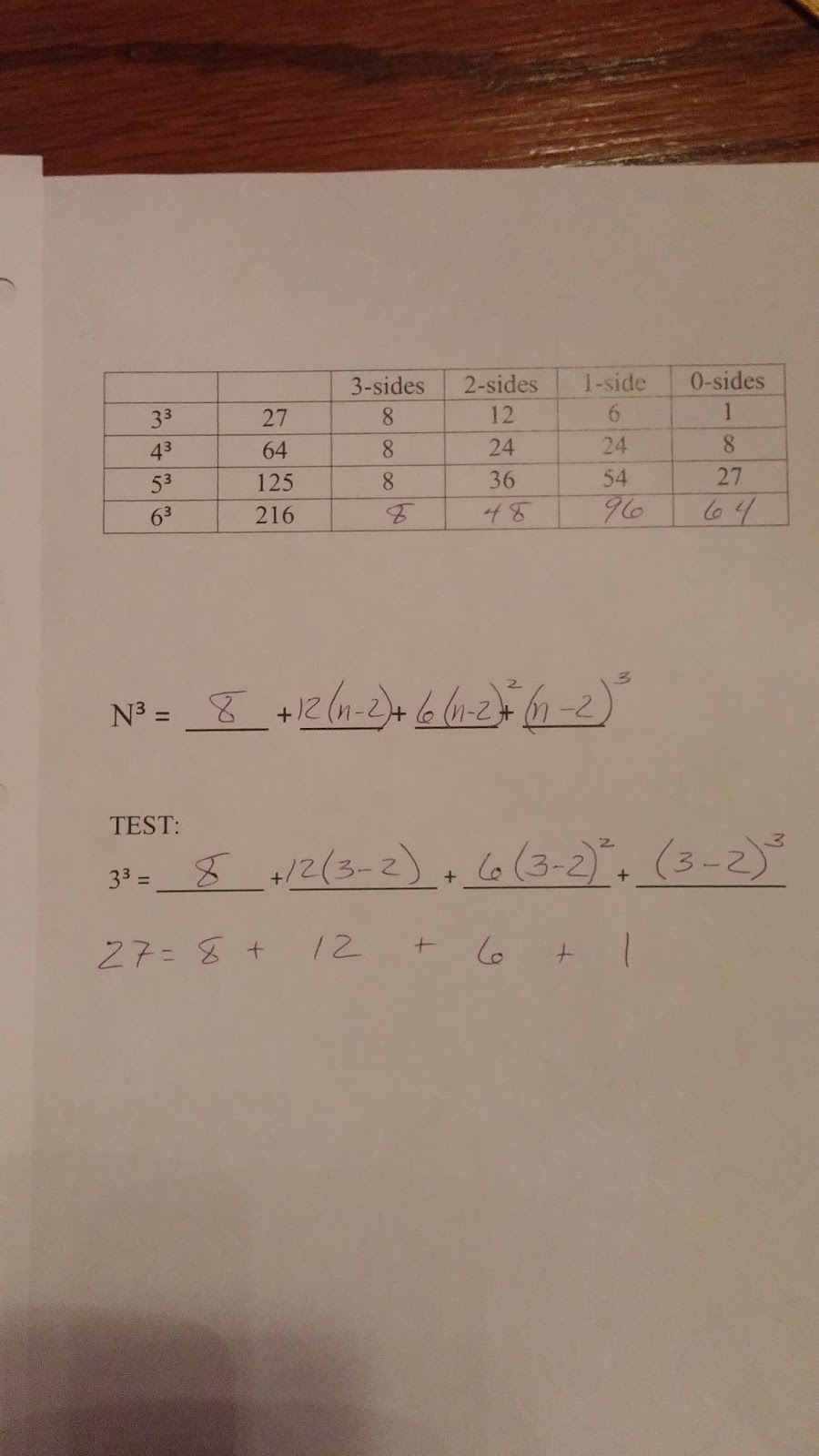
Instructions for how to manipulate Desmos Graphing Calculator were given using a former chart (Painted Cube sides).

Painted Cube Sample

Students were given time in class to complete (then share to me) via their graph via Desmos Account.

HOMEWORK:  1.  IF NOT FINISHED IN SCHOOL --  MUST table and line equation for both teams from the video then SHARE with Mrs. Warren via email. If you have any problems, SEE me first thing tomorrow MORNING.

2. Complete Reflection Questions.


ACT 3 (THE FINAL ANSWER) WILL BE SHARED ON TOMORROWS BLOG POST.

October 18, 2016

Ditch Diggers

As students entered the classroom, "Raider's March" was playing to set the mood. A portion of a video clip was displayed in order for students to see how tunnels are dug in modern day (background knowledge).

I have taken a Dan Meyer lesson (see his bio below) and adapted it for our students. The team will be working on a problem of "ditch diggers" beginning a tunnel at two opposite points. Students will determine as to whether or not the tunnel will meet in the middle (we certainly hope it will).

The first part - or as Mr. Meyer calls it, Act One - requires the students to watch a video (23 seconds long) and answer the questions in their MTN.

Tunneling Machine

Act One Video

MTN Questions

BIO:
Dan Meyer is a former California high school math teacher. He worked with students who didn't like math and believes in better math instruction. He has been a guest on a number of talk shows, spoken internationally as well as TED Talk, and recently earned a doctorate from Stanford University in math education. He is now the Chief Academic Officer at Desmos and still striving to improve math education for all students.

HOMEWORK:  1. Complete the "Ditch Diggers -- Act One" questions in your MTN.
2. Test out this link on Cool Fractals from a Bella find.  Fractal Link

October 17, 2016

Fractal Homework

Over half the team still need to turn this in. You can take a pic and share with me via the school email - OR - take a pic, print at home and bring in to school - OR - sketch the item in nature that is represented in nature.  Get it done!

Tuesday and Wednesday -- Cool math project coming up.

October 13, 2016

Fractals in Math and Nature

After a discussion from last night's homework, we viewed other samples of fractals. Notes were given on Fibonacci Sequence and an exponent tree (both fractal examples).

Here is a sample copy of one group's notes:


Fractal Pack

While viewing the samples from the above link, students completed questions in their individual MTN's.  Then followed directions to creating an example of a fractal watershed.

HOMEWORK: Take a photo of at least one fractal in nature. Share with Mrs. Warren before 7:30 pm Sunday, 10/16/16 via email.


October 12, 2016

Mini-Eval#1 and Fractal Intro

Most students completed their first summative math assessment -- Mini-Eval. Those students wanting more time can finish before advisory or during A-Block tomorrow moring.

Tomorrow, we will examine fractals and watersheds. In order for students to have some background knowledge of fractals, they will have 2 questions to answer in their MTN. Their answers will help keep track and record their discoveries.

This is the link that will help you answer both questions:
Fractal Foundation

Here is the link to the blue handout (in case you forgot your MTN at school):
Fractals (handout for MTN)

HOMEWORK:  Complete the blue handout in your MTN.

October 11, 2016

Review, PEMDAS, & Exponents

Today was used to review the notes from last Wednesday and practice PEMDAS with the expression derived from Painted Cube project. The Mini-Eval will be given tomorrow.

Here are 3 posters from last week's group work. They demonstrate how groups were able to visualize and work out the problem to a solution to the given question. Ask your child about the question.


HOMEWORK: Mini-Eval #1 is tomorrow.

October 6, 2016

NWEA Testing

Math classes were not held due to NWEA Testing.

HOMEWORK: Read over Painted Cube and Square/Cube Notes for Mini-Eval #1 on Wednesday.

October 5, 2016

Quick Review for Mini'Eval #1

Here is a copy of teacher notes from today:


***SPECIAL NOTE:  Mini-Eval #1 has been changed from tomorrow to Wednesday, 10/12/16.

HOMEWORK:  Read over Painted Cube and Square/Cube Notes for Mini-Eval #1 on Wednesday.

October 4, 2016

PC Presentations & Square/Cube Notes

Students were given 20 - 25 minutes to polish their group poster and prepare their shared presentation to class.  Groups were given 2-3 minutes to present their findings.

Tomorrow, students will participate in a YouCubed Survey about the math problems which we have tackled over the past couple weeks. Then square/cube number notes will be given to students.


HOMEWORK:  Look over Painted Cube and Notes in MTN for Mini-Eval #1 on Thursday.

October 3, 2016

Painted Cube Group Share

Today, students continued working in groups.  The groups must design a method that best demonstrates their understanding of given questions for cubes that measure 3x3x3, 4x4x4, 5x5x5, and relate to the growth pattern for cubes with larger measurements.

Below are photos of students working:


HOMEWORK:  Be prepared to present with your group tomorrow.

September 28, 2016

Good Group Work and Painted Cube

THIS POST IS FOR WEDNESDAY, 9/28 AND THURSDAY, 9/29!

In order to allow sufficient time to complete a field study in science, math and science classes are double blocked for today and tomorrow. Thus, anyone in math today or tomorrow, had a lot of work to complete both individually and in groups.

FIRST:
Good Group Work Project -- Now you are to organize the patterns that you can view among all the posters. Click onto your class Padlet to add post-its, rearrange, sequence in order, etc. until we have a class poster. (This was for in-class only --- not at home. All Padlet pages will be turned to "Read Only" at 2:30).

(As of 2:30 on 9/29, all Padlets will be in "Read Only" mode.)

SECOND:
Students were shown a sample 3x3x3 cube with manipulatives and  projection. In their MTN's students needed to answer the following independently:
If we took a 3x3x3 cube and dipped it into paint, so the paint completely
 covered the cube, how many small cubes would have
three sides painted? Two sides painted? 
One side painted? No sides painted?

Then student groups were given centimeter cubes to make their own 3x3x3 cube to investigate. Students were provided with chart paper to record their findings. They were then instructed to predict the same for 4x4x4 cube, 5x5x5 cube, and beyond. It was recommended to students devise a plan to best organize their data for presentation. Group assignments were as follows: 1. Project Manager, 2. Encourage & Strategies Checker, 3. Block Builder & Materials Caretaker, and 4. Recorder.

HOMEWORK:  None for tonight.

September 27, 2016

Hailstone Sequence Share

Students had an opportunity to show their trials with Hailstone Sequences.  All expressed the fun that was had with math!  Students were also able to share a variety of information learned from last night's links and added to their notes.

We then discovered conditions that led to fewer steps and examined whether or not negative integers work and why.

Here is a calculator link that reveals the number of steps necessary to reach "1" from any positive integer.
Hailstone Sequence Calculator


HOMEWORK: 
  • Play with MIT Hailstone Calculator and jot down observations.

September 26, 2016

Conjectures

First, class began with a new vocabulary word: conjectures. Students were given a process for math vocabulary words using word origin (which will be covered more in depth in SSEnglish classes). After the individual parts to the word was given, students brainstormed possible definitions. Then I shared a math definition and synonym. This process has a page dedicated in students' MTN's and will be followed throughout the year.

Then students were given the following handout with additional information:

Tonight, students will calculate their own hailstone sequence and check out additional information on the provided links about Hailstone Sequences.

HERE ARE THE 3 LINKS FROM WHICH TO CHOOSE:
1.  Wolfram
2.  NASA Hailstorm
3. Wikipedia


HOMEWORK: 
  • 1. Begin with a number between 50 and 100. Following the Hailstone Sequence String rules, complete the calculations till you arrive to 1 (one).
  • 2. Go to my Blog and check out any one of the three links. Write two things you learned.

September 21, 2016

Overnight Prep

Due to shortened Delayed Opening Schedule, an unexpected -- although pleasant surprise -- guest speaker, and the last chance to complete: final-gear-checks-nature-journal-preview-water-bottle-filling-pack-labeling . . . . we did not have core classes today.


We will see you on Friday around 2:00ish and the next post will be on Monday, 9/26.

HW: None for tonight.

September 20, 2016

Squares to Stairs -- Part 2

After checking completed homework, students were instructed to draw a line across the page under their work. As an individual student shared her/his thinking and work, the remaining students copied the ideas in their MTN with a different colored writing utensil. At the end of each class, I collected all MTN's in order to determine "Practices improved skills," one of the Work Ethic Process Grades. While I have students' MTN's I will also be evaluating another process grade: "Demonstrates perseverance to meet task requirements, AND two Math Practice Grades: "Makes sense of problems & persevere in solving them." AND "Model math by applying math to solve problems."  The final component that I will be examining is students' understanding of "squared" and "square root".
I also had each student create an account for Desmos Graphing Calculator. We were able to enter one expression and I suggested to students to "play" with other possibilities.    Desmos Screenshot

HW:  There is not homework tonight (and will not be any assigned work till we return on Monday, 9/26).

September 19, 2016

Squares to Stairs

We began class with a table mates sharing of individuals' growth patterns from last Thursday's work. Then all shared in a whole class discussion. It was interesting to watch the color designs along with the verbal explanations to how students interpreted the growth patterns.

Students were shown how to express the stairs growth pattern in a table. . . . .:
. . . .and from there, we were able to write an algebraic expression.


Some students claimed to understand HOW this works while others were still uncomfortable with WHY and HOW this expression works -- and that is okay. Everyone "gets it" at a different pace.

Here is a link that can further your understanding (or maybe not):
Techniques for Adding the Numbers 1 to 100


HW: Answer the following in your MTN: Can you use 190 squares to make a stair-like structure? Justify you thinking with different representations -- visually, numerically, and algebraically.  WORK ON THIS FOR AT LEAST 20 MINUTES.

September 15, 2016

Graph Process & Squares to Stairs

Most students came to class with a variety of topics for their homework graphs.  A number of students took the extra time and to include elaborate and creative representations on their graphs. Students were also able to express their understanding of graphs and interpret the data in order to draw conclusions. The errors that were made led to good processing discussions.


Our classes were slightly shorter in order to allow time tent set ups. We began the activity titled, Squares to Stairs. We will complete the remainder of the discussion and writing an algebraic expression on Monday.

Students do not have any homework --- BUT --- can always play with more growth patterns in their MTN.

THE NEXT POST WILL BE ON MONDAY.

September 14, 2016

Graphing Activities

We began our class time with reviewing student ideas and solutions from last night's homework, Fewest Squares. Share with your family the results we discussed in class.

A short video clip from Dr. Jo Boaler was shown to students about the making mistakes and making corrections versus making irresponsible decisions.

A graph without numbers was given to table mates and students needed to interpret the information. After the whole group processed the graph, students were assigned to create their own graph.  They are allowed to choose any topic and must include 2 dimensions.

September 13, 2016

Dot Card & Good Group Work

Today's lesson was in three parts: 1) Dot Card, 2) Good Group Work, and 3) Fewest Squares.

Students were allowed to look at a card for 1 second, and were then asked how they saw the dots arranged to arrive at 6. Here are the results from three classes.


We then processed the objective of this activity.

Students discussed "Good Group Work" actions -- what it looks like -- what it sounds like to observers.  Students wrote these ideas in their MTN's. We also discussed what might detract good group work and how to solve those situations.

Finally, I described the expectation for tonight's homework . . . "Work  on Fewest Squares for at least 20 minutes.

September 12, 2016

Problem Solving & Math

We began our year with setting up our math composition books, which will be referred to as MTN's (Math Thinking Notebooks). Table of Contents (TOC) pages were set aside and labeled. Each day, I begin class with the date and title of the day's activity. Then, students were given Polya's Problem Solving Strategies that you can reference as a page tab near the top of this blog. Students were also given a list of possible plan ideas for math problem solving. Both sheets have been taped on the inside cover of their MTN's for easy reference. We spent a good deal of time processing how to use these strategies.

Then I introduced Week of Inspirational Math -- Year 2 from Dr. Jo Boaler of Stanford University. Over the next 5 days, students will be involved in problem solving situations in order for them to understand that math can be seen in many different and creative ways. Students who took part in these activities last year spoke highly of that time, and I also observed how students referred to these days as the basis for persevering some difficult problems during the entire school year. At the end of the five days, students will complete a survey and I will invite parents to complete the survey, if so desired.